Mechanical Aptitude Test: free practice
The machines behind mechanical reasoning questions: gears, belts, balanced beams and pulleys. Free practice where every answer is worked out from the picture.
Start here
Free and unlimited, no account needed.
What is a mechanical aptitude test?
Mechanical aptitude tests (also called mechanical reasoning or mechanical comprehension) ask how simple machines behave: which way a gear turns, what balances a beam, how much force a pulley saves. You do not need an engineering degree. Nearly every question applies a handful of school-physics rules to a picture.
The tests are usually multiple choice with one picture per question. Seeing which rule applies is the skill, and it improves quickly with practice.
Where you will meet it
The question types, and where to practise each
Gears, belts and axles
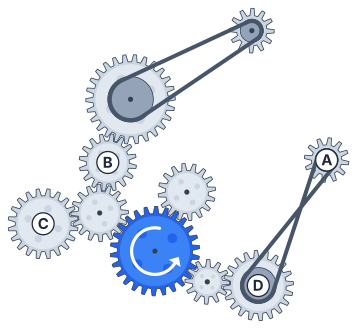
A blue gear drives a train of gears, belts and axles. Which lettered gear turns clockwise, and which turns fastest? Four rules answer every question: touching gears turn opposite ways, an open belt keeps the direction, a crossed belt reverses it, and two gears on one axle turn as one.
Levers and balance
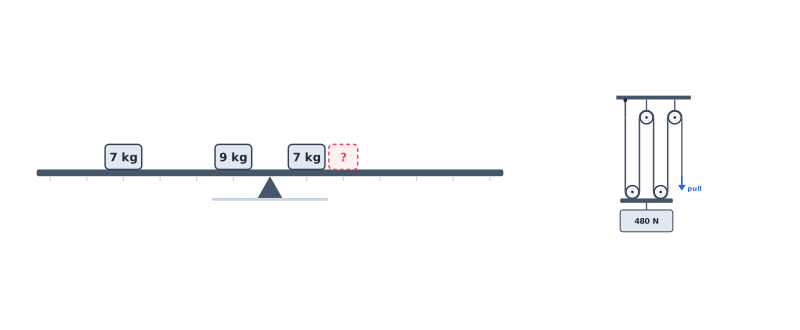
A beam balances when weight times distance is the same on both sides of the pivot. Questions ask which weight balances the beam, where a weight must go, or how a beam hanging from a beam balances.
Pulleys: force and distance
A rope system holds its load with the load divided by the rope segments that carry the moving block, and the load rises that many times less than the rope you pull. Questions ask for the force needed, how far the load rises, or which of four systems needs the least force.
Tips that work
- Start at the driver and trace link by linkFor gears, begin at the gear that is turned and follow the motion one contact at a time. Guessing from the whole picture is how people go wrong.
- Count contacts for directionEach pair of touching gears flips the direction; an open belt does not; a crossed belt does. An even number of flips means the same way as the driver.
- Smaller gears turn fasterWhere gears touch or share a belt, their rims move at the same pace, so the one with fewer teeth turns faster. Along a plain train only the first and last sizes matter for speed.
- Beams: multiply, then compareWrite weight x distance for each side. Equal products balance. A weight twice as far from the pivot counts double.
- Pulleys: count the supporting ropesForce = load / number of rope segments holding the moving block. The pulled end counts too when it pulls upward from the block.
- What you save in force you pay in distanceHalve the force and you pull twice the rope. Use that to check any pulley answer.
Common traps
- Treating every belt as a flip. An open belt keeps the direction.
- Assuming every pulley halves the force. Only the ropes holding the moving block count.
- Picking the system with the most pulleys or the lightest load. Count rope segments instead.
- Picking the smallest gear as the fastest. An axle pair changes the rim speed, so size alone does not decide it.
What is not here yet
Mechanical tests sometimes also ask about hydraulics, springs, inclined planes and simple electrical circuits. AZTest covers gears, belts, levers and pulleys so far.
Questions people ask
What is on a mechanical aptitude test?
Pictures of simple machines with multiple-choice questions: gears and belts, levers and balance, pulleys, and often hydraulics, springs, ramps and basic circuits. Tests are used for technical, trade, military and emergency-service roles.
Do I need to know physics formulas?
Only a few, and they are explained here: weight x distance for a beam, load divided by rope segments for a pulley. Many questions can be answered by reasoning about direction and which side is heavier.
Is this practice free?
Yes. The gears and levers and pulleys tests are free, unlimited and need no account.
Can I print this?
Yes. The worksheet maker produces printable sheets of gears and levers and pulleys questions with answer keys, and free sample PDFs are available without an account.
Are these the real tests?
No. AZTest is independent and not connected to the publishers of the tests named above. This is practice for the question types.
Ready? Start with one test
Ten minutes a day is enough to notice the difference. Read the review after every session: it shows the right answer and why.
Start the Gears test Also in the IQ Test & Brain Training appMore test prep
AZTest is independent and not connected to the publishers of the tests named on this page. Test names belong to their owners. This is practice for the question types, not the official tests.