Spatial Reasoning Test: free practice
Fold the net, turn the shape, unfold the paper, all in your head. Free, unlimited practice with a review of every question.
Start here
Free and unlimited, no account needed.
What is a spatial reasoning test?
A spatial reasoning test asks you to picture a shape and what happens to it: folded into a cube, seen from another side, turned round, cut or punched. There is nothing to revise. It measures how well you can hold a shape in mind and move it.
Questions are multiple choice, one picture and several answers, and most tests are timed, so speed counts as well as accuracy.
Where you will meet it
The question types, and where to practise each
Paper folding and cube nets
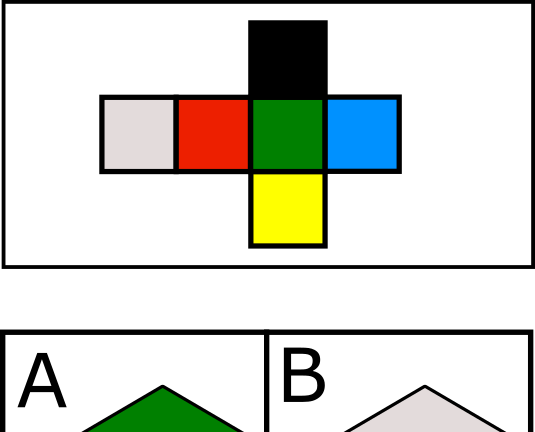
A flat cross of six squares is folded into a cube. Which cube can it make, or which net makes this cube? The skill is knowing which faces end up opposite each other and which end up side by side.
Views of a 3D shape
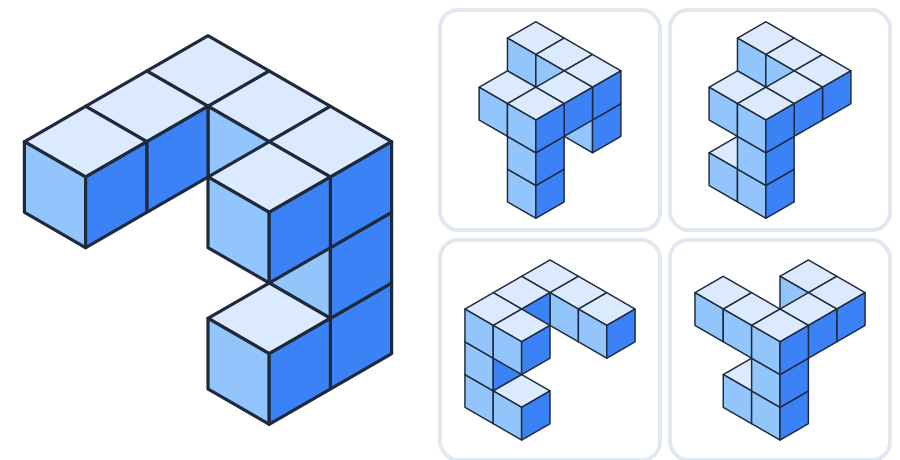
A shape of cubes is drawn from one corner, so three of its sides are hidden. Which flat picture is a true view from the front, side or top, or which picture cannot be a view at all?
Mental rotation
Which drawing is the same shape, only turned? The others are its mirror image or a shape with one cube moved. These are the Shepard-Metzler figures from psychology research.
Fold and punch
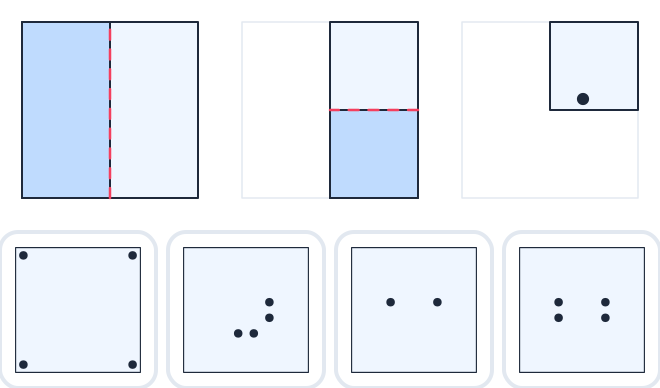
A sheet of paper is folded one to three times and a hole is punched through every layer. Which sheet shows the holes once it is unfolded?
Fitting and assembling pieces
Fit fragments into a target silhouette, or put sliced pieces back into a letter. This tests how well you turn and fit flat shapes.
Tips that work
- Name a landmark, then follow itPick one face, mark or arrow and track where it goes. Following one feature is far easier than turning the whole shape.
- In a cube net, find the opposite faces firstTwo squares in a straight line with exactly one square between them are opposite faces, and opposite faces never touch on the folded cube. That removes most wrong answers at once.
- Eliminate on one detailCheck where a single stripe, dot or arrow points and cross out every option that has it wrong. Rotating every option in full is slow.
- A mirror image can never be turned into the originalIn rotation questions, look for a bend or twist and note which way it goes. Wrong answers are often the mirror image: the same shape but the other hand.
- Fold and punch: unfold in reverseUndo the last fold first. Each unfold copies every hole across that fold line, like a mirror. Each fold doubles the layers, so one punch usually becomes two, four or eight holes.
- Practise with real paperFold a sheet, punch a hole, unfold it. Two minutes of this builds the intuition these questions test.
Common traps
- A shape drawn from one corner shows only three sides. The questions are often about the three you cannot see.
- Distance on the flat net misleads. The two end squares of a row of four are far apart on the page but touch once folded. Use the one-square-between rule for opposites.
- A wrong answer costs points, so guess only after you have crossed out options.
Questions people ask
What is a spatial reasoning test?
A multiple-choice test of how well you can picture shapes and their changes: folding, rotating, viewing from another side, cutting or assembling. It is used in school, engineering, design and flying-role selection, and as part of IQ tests.
Can you improve at spatial reasoning?
Yes. Reviews of the research find that spatial skills can be trained. Short regular sessions, a few minutes a day, are a sensible way to do it.
How is this practice scored?
Each right answer earns points and a wrong one costs some, so guessing blind does not pay. Where AZTest has norms for a test, the result also shows an IQ-style score and a percentile for your age.
Do I need an account?
No. Every practice test here is free and needs no sign-up. Signing in only saves your history.
Are these the real tests?
No. AZTest is independent. This is practice for the question types, not the official tests.
Ready? Start with one test
Ten minutes a day is enough to notice the difference. Read the review after every session: it shows the right answer and why.
Start the 3D Cube Folding test Also in the IQ Test & Brain Training appMore test prep
AZTest is independent and not connected to the publishers of the tests named on this page. Test names belong to their owners. This is practice for the question types, not the official tests.