Unlimited Dynamic Practice
Fresh, procedurally generated questions every run — spatial folding, sequence ladders, word synthesis, mechanical and electrical reasoning, working memory span, and speed arithmetic. Calibrated against the AZTest normative database.
Playing with friends or a class? Open a Puzzle Room — everyone gets the same puzzles and a live leaderboard.
Prefer paper? Print a worksheet — pick the type, difficulty and length, with an answer sheet.
Spatial, Logic & Pattern Games
Procedural aptitude batteries: cube folding, 3D views and rotation, paper folding, sequence ladders, letter synthesis, and board partitions.
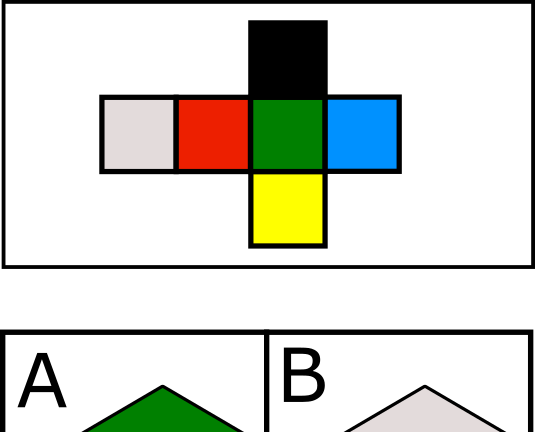
3D Cube Folding
Visualize 2D unfolded topological patterns and identify their 3D isometric folded cubes.
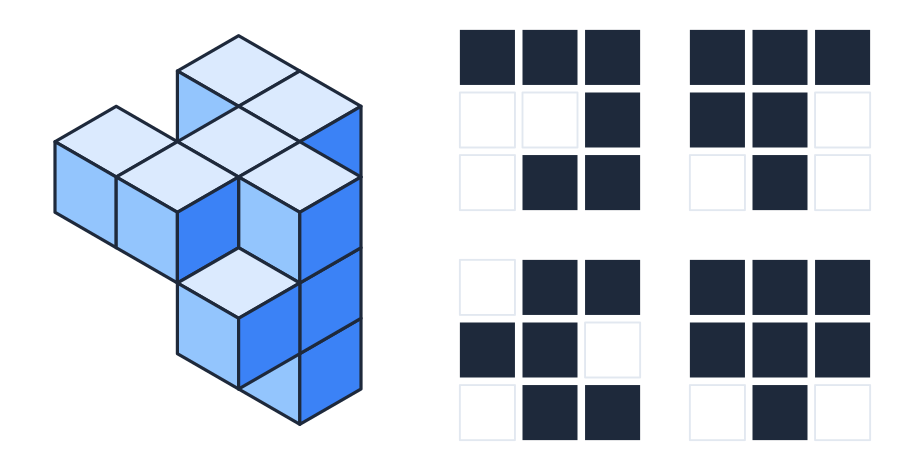
3D Views
A shape of cubes drawn from one corner, and four flat pictures. Only one shows it straight on from one of its six sides -- perhaps a side the drawing hides. Find the real view.
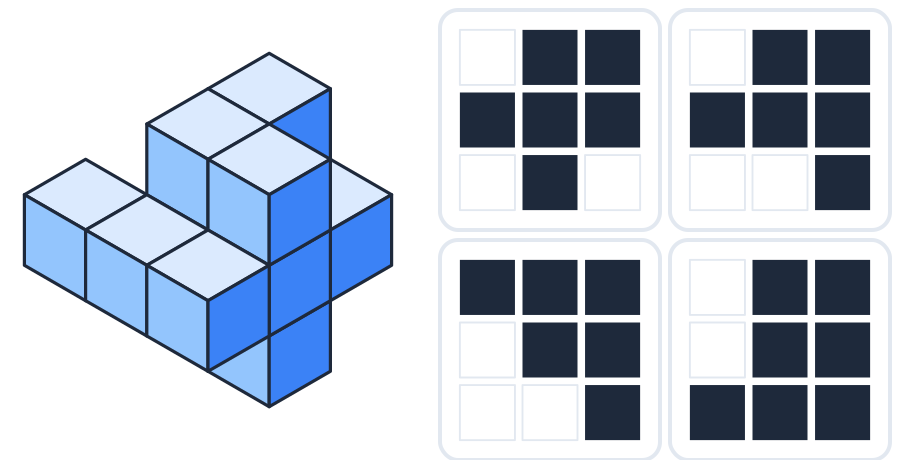
3D Views: Find the Wrong One
A shape of cubes drawn from one corner, and four flat pictures. Three show it straight on from one of its six sides -- the hidden ones too. Find the one that is no view of it at all.
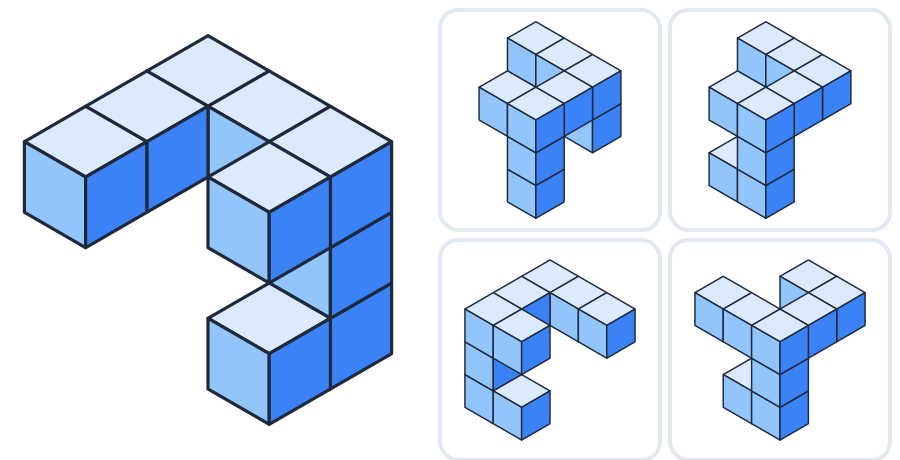
3D Rotation
Shepard-Metzler mental rotation. Which of four drawings is the shape of cubes above, only turned? The others are its mirror image or a shape one cube different, turned as well.
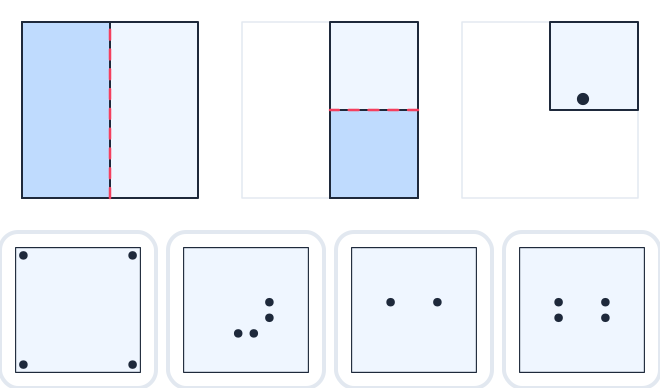
Fold & Punch
A square sheet is folded one to three times, then a hole is punched through every layer. Unfold it in your head and pick the sheet with the right holes.

Number Series
Find the missing number. The sequences climb through arithmetic, geometric, alternating and recursive families as you keep getting them right.
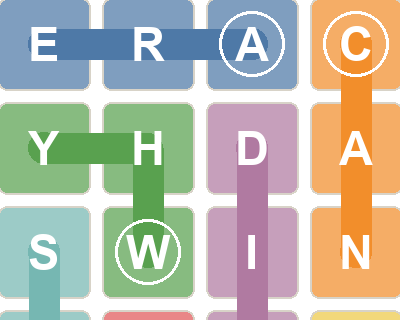
Word Grid
Cover the whole grid with words. Trace each one up, down, left or right -- never diagonally -- and spell it forwards. Each grid you finish is bigger than the last.
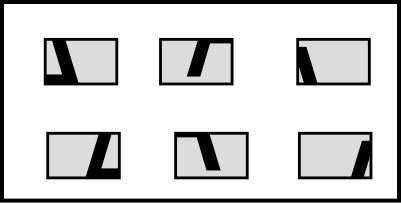
Sliced Letters & Paper Cut
Synthesize cut, rotated, and shuffled glyph tiles to identify target letters and words.

Word Unscramble
Unscramble the word, then say which category it belongs to. The words lengthen as you keep getting them right.
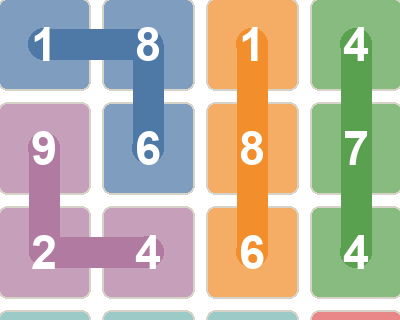
Number Grid
Cut the whole grid into groups that each add up to the target. Trace a group up, down, left or right -- never diagonally. Each grid you finish is bigger than the last.
Mechanical & Electrical Reasoning
The everyday-physics questions of mechanical aptitude tests: gears, levers and pulleys, tanks and pipes, springs, what tips over, electric circuits, and linkages. Every question is worked out from the numbers in its picture.
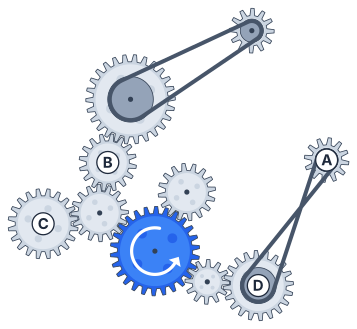
Gears
Mechanical reasoning: a train of gears, belts and axles driven by a blue gear. Which lettered gear turns clockwise, which turns fastest? Trace the motion link by link.
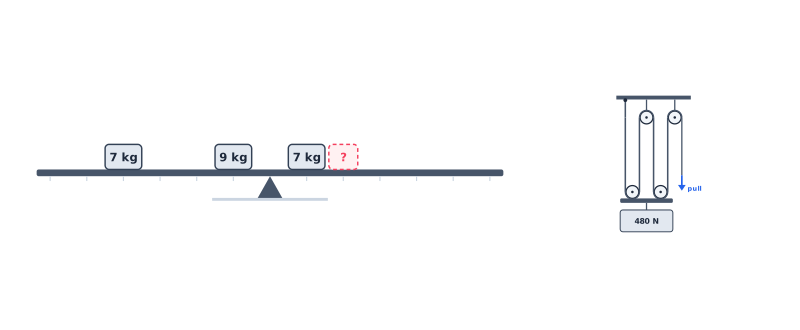
Levers & Pulleys
Mechanical reasoning: balance a beam, then a mobile; find the force a rope system needs and how far its load rises. Every question is worked out from the picture's own numbers.
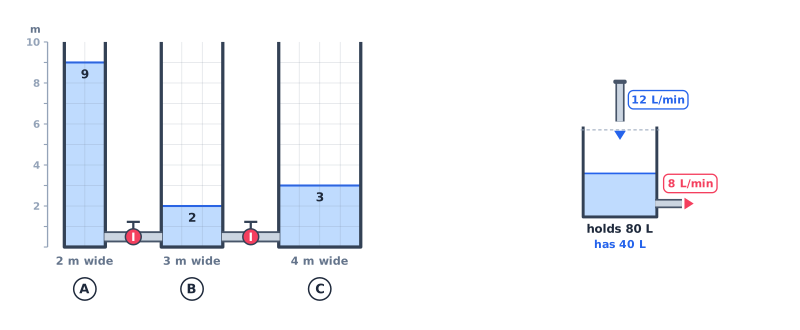
Tanks & Pipes
Mechanical reasoning with water: how long a tank takes to fill, which of four is full first, and where the water settles when tanks are joined. Every question is worked out from the picture's own numbers.
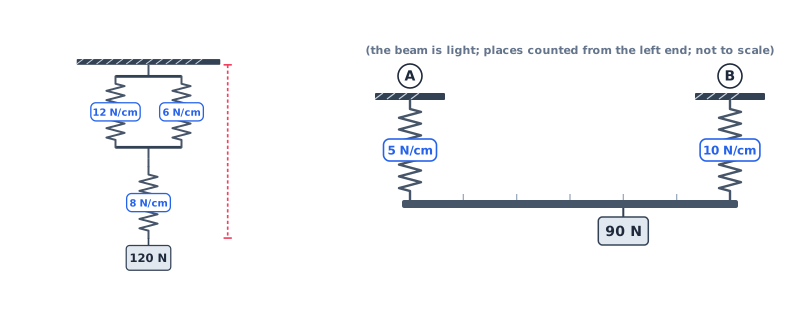
Springs
Mechanical reasoning with springs: how far a load stretches one spring, how long it is with the load on, and how springs side by side, one below another, or holding a beam share a load. Every question is worked out from the picture's own numbers.
Stability
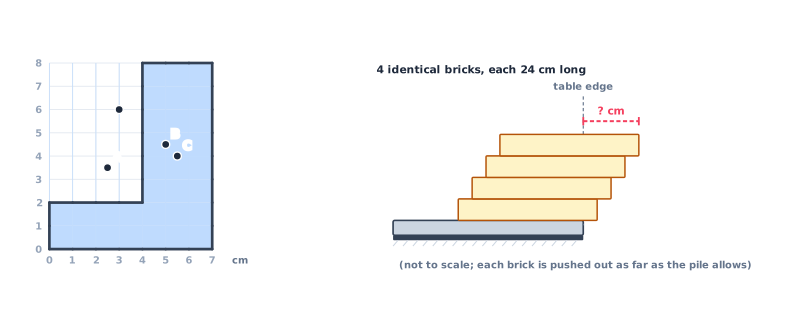
Mechanical reasoning about balance: which box is hardest to tip, how steep a board can be before a box falls, how far a plank or a pile of bricks can reach over a table's edge, and where the centre of gravity of a flat plate lies. Every question is worked out from the picture's own numbers.
Electric Circuits
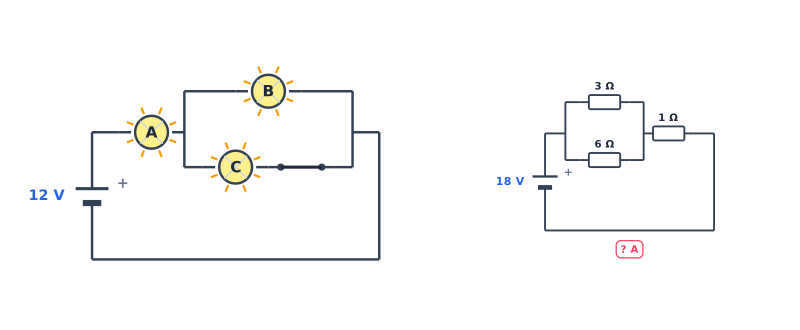
Mechanical aptitude with electricity: which bulb lights, which is brightest, what a switch or an extra bulb does, and the current, resistance, voltage and power in a circuit of resistors. Every question is worked out from the picture's own numbers.
Linkages
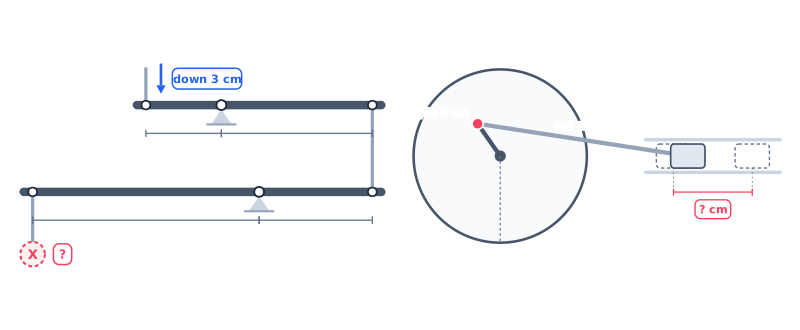
Mechanical reasoning with rods and pivots: which way a rod moves, how far and with what force the end of a lever or of a chain of levers moves, what a bell crank does, which piston has the longest stroke, and how far a cam lifts its follower. Every question is worked out from the picture's own numbers.
Working Memory & Cognitive Span
Staircase span challenges: digits, letters, animal sprites, and spatial matrix recall. Grows until you slip.
Numerical Sequence Memory
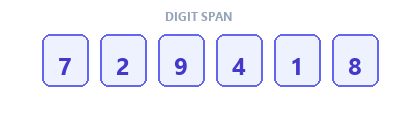
Digits flash up, then vanish. Type them back in order. Every clean round adds one more.

Alphabetical Sequence Memory
A run of letters, shown and then hidden. Reproduce it in order; it grows each time you do.

Picture Sequence Memory
A sequence of animals to hold in mind and tap back in order. Harder than digits, and the norms say so.

Grid Memory
Tiles light up across a grid. Mark them again once they go dark -- in any order, but all of them.

Chimp Memory Test
Numbers appear scattered across the board. Tap 1 and the others go blank, then tap them in order from memory. Each clean round adds one number.

Path Memory
Tiles light up one after another. When the path ends, tap the same tiles in the same order. Each clean round adds one tile.

Backward Path Memory
Tiles light up one after another. When the path ends, tap the same tiles in reverse order, last one first. Each clean round adds one tile.

Backward Numbers
Digits are shown for a few seconds. Type them back in reverse order, last digit first. Each clean round adds one digit.

Where Was It?
Pictures are shown on a board, then covered. A picture appears below: tap the tile it was on. Each clean round adds one picture.

Card Pairs
Cards lie face down. Turn two at a time to find the pairs. Clear the board with no more misses than pairs and the next board has one more pair.
Mental Arithmetic Speed Ladders
Adaptive speed drills for addition, subtraction, multiplication, and division that calibrate to your reaction speed.

Mental Arithmetic: Addition
Add the two numbers. The questions climb a ladder ordered by how long each band actually takes to solve, settling where you are right 85% of the time.

Mental Arithmetic: Subtraction
Subtract the second number from the first. The questions climb a ladder ordered by how long each band actually takes to solve, settling where you are right 85% of the time.

Mental Arithmetic: Multiplication
Multiply the two numbers. The questions climb a ladder ordered by how long each band actually takes to solve, settling where you are right 85% of the time.

Mental Arithmetic: Division
Divide the first number by the second. The questions climb a ladder ordered by how long each band actually takes to solve, settling where you are right 85% of the time.

Mental Arithmetic: Mixed
All four operations, drawn at random. The questions climb a ladder ordered by how long each band actually takes to solve, settling where you are right 85% of the time.
Risk & Decisions
Weigh a growing prize against the chance of losing it. Educated risk pays; reckless risk does not.
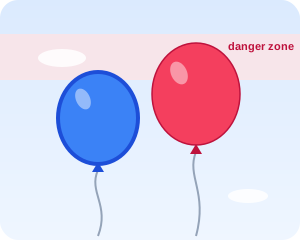
Balloon Edge
A risk-taking game. Each pump pays more than the last, and each balloon has a danger zone where it can pop. Stop before it and you leave points behind; go too deep and you lose them. Find the edge.
How Infinite Practice Works
Every test run generates completely new random problem configurations, so you never encounter duplicate questions. Scores are evaluated using the AZTest difficulty formulas and calibrated against standardized age norms.