Numerical Reasoning Test: free practice
Find the rule hiding in the numbers. Adaptive number series practice, four more number question types, and a lesson for every kind of sequence.
Start here
Free and unlimited, no account needed.

What is a numerical reasoning test?
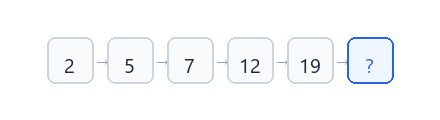
Numerical reasoning tests come in two kinds. Some give you a table or chart and ask for a percentage or a ratio. Others, the kind on this page, hide a rule in a set of numbers and ask you to find it: the next number in a series, the missing cell in a grid, the number that completes a pair.
Pattern questions reward a method more than talent. Look at the gaps, look at the ratios, check the rule against every term. The lessons below teach each family of sequence.
Where you will meet it
The question types, and where to practise each
Number series
Find the missing number. The sequences climb through arithmetic, geometric, alternating and recursive families as you keep getting them right, and each family has its own lesson.
Number matrices
A 3x3 grid of numbers with one cell missing. The rule runs along the rows, down the columns, or both: sums, products, differences or something built from them.
Numerical analogies
A : B :: C : ? Find the operation that turns A into B, which may take two steps, and apply it to C.
Number networks
Arrows between circles carry operations. Work out what each arrow does from the complete parts of the network, then fill the missing node.
The arithmetic underneath
Every pattern question is easier when the sums take no effort. Mental arithmetic practice and shortcut lessons buy back the seconds.
Tips that work
- Write the gaps between termsConstant gaps mean an arithmetic series. Gaps that themselves grow by a constant mean a squared pattern. A constant ratio between terms means a geometric series.
- Look for two series woven togetherIf odd and even positions behave differently, split the series in two and solve each half.
- Try the sum of the previous twoFibonacci-style rules, where each term comes from the ones before it, hide in plain sight when the gaps look irregular.
- Check the rule on every termA rule that fits the first three terms may fail on the fourth. Test the whole series before you answer.
- Learn the landmarksSquares to 15 x 15, cubes to 10 x 10 x 10, powers of 2 and the primes under 50 turn up constantly. Spotting one turns a puzzle into a lookup.
- In grids, test rows and columns separatelyTry sum, product and difference across each row, then down each column, before looking for anything more exotic.
Common traps
- Assuming the series is arithmetic because the first two gaps match.
- Stopping at the first rule that fits. Several rules can fit the same few terms, so use one that explains every term.
- Mistakes in the arithmetic itself, not the pattern. Slow, careful sums beat quick wrong ones.
What is not here yet
This page covers the pattern-finding side of numerical reasoning. Questions that ask you to read tables and charts, such as percentage change and ratios from data, are not on AZTest yet.
Questions people ask
What is a numerical reasoning test?
A test of working with numbers to find a rule or a result. Some versions use data tables and charts; others, like the ones here, use number series, grids and analogies.
How do I get better at number series?
Learn the families (arithmetic, geometric, alternating, recursive, polynomial) and practise spotting which one you are looking at. Each family has a short lesson with worked examples on this site.
Do I get a score?
Practice shows points and an accuracy. The timed number tests give an IQ-style score with a percentile normed for your age.
Is it free?
Yes, and no account is needed.
Are these the real tests?
No. AZTest is independent and not connected to any test publisher. This is practice for the question types.
Ready? Start with one test
Ten minutes a day is enough to notice the difference. Read the review after every session: it shows the right answer and why.
Start the Number Series test Also in the IQ Test & Brain Training appMore test prep
AZTest is independent and not connected to the publishers of the tests named on this page. Test names belong to their owners. This is practice for the question types, not the official tests.