3D Cube Folding
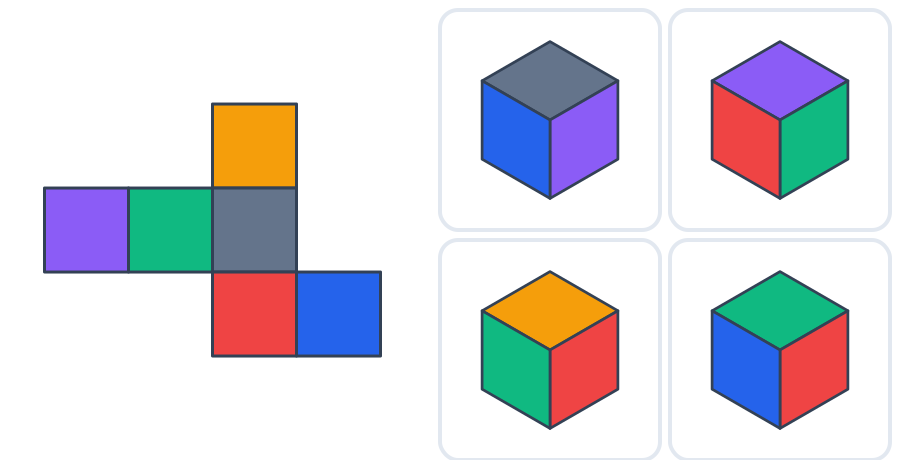
Fold the flat pattern into a cube.
- 2 minutes, then it ends
- Free, no sign-up
- Adapts to you
About this test
Folding a net into a cube in your head is a standard item in spatial-ability tests and in the aptitude tests used for engineering and design courses. A good habit is to pick one face as the base and track where its neighbours end up.
The questions adapt to you: you see a flat pattern and four cubes, and only one cube can be made from it.
What it measures: Spatial visualisation: folding and rotating shapes in your head.
The 11 nets of a cube
A net is a cube cut along seven of its twelve edges and laid flat: six squares joined edge to edge. Turned and mirrored copies aside, a cube has exactly 11 nets, and every question in this test uses one of them.
All 11 below are the same cube, so each colour is the same face in every net. Tap a net to watch it fold.
Drag the picture to turn it. The slider folds and unfolds the net.
- Squares that share an edge in the net share an edge on the cube.
- In a straight row of three squares, the first and the third end up opposite each other. Here blue is opposite grey, pink opposite green and yellow opposite purple.
- Two opposite faces are never seen at the same time, so a cube that shows both cannot be right.
- Where two squares make an L, the two squares at its ends will meet along an edge once folded.
How it works
Visualize 2D unfolded topological patterns and identify their 3D isometric folded cubes.
Your result is ranked against other players with a percentile.
Try it now
Takes a few minutes, and you get your result at the end.
Start the test Also in the IQ Test & Brain Training app